Clasp Raises $20M Series B to Scale ROTC Model for Clinician Retention in Healthcare
Nearly 50% of clinicians leave their first job within just two years (yikes). Every time I say that out loud, the room goes quiet. Because everyone knows it’s true — and somewhere along the way, we decided that was just the cost of doing business.
Here’s how the cycle goes in healthcare:
- We hire someone.
- We pay them a sign-on bonus to join.
- They leave to chase yet another sign-on bonus.
- We pay someone else a sign-on bonus to fill the gap.
- And we repeat the cycle.
That’s the problem Clasp is built to break. And it’s why I’m so proud to announce our $20M Series B today(!!).
As I think about what got us here, I keep coming back to the same question: Why are we still surprised when clinicians don’t stay?
I got the clearest answer I've ever heard from a health system executive. She stopped me mid-conversation and said, “Everyone uses them, but I hate sign-on bonuses.” No hesitation. I asked “why?”. She said, “They reward leaving more than staying.”
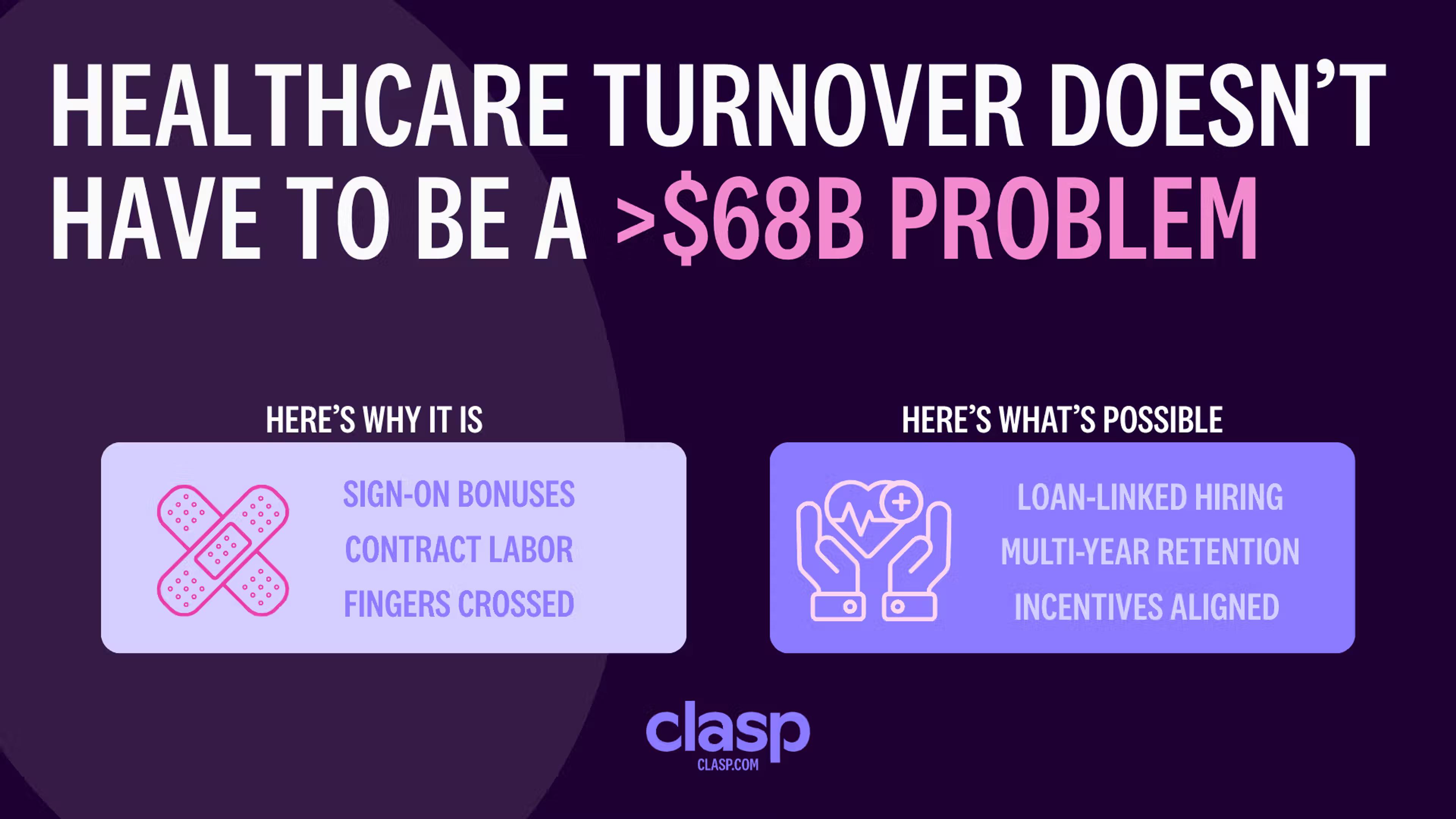
Sign-on bonuses help people say yes. They do not give them a reason to stay. And yet we’ve built an entire system around them. Healthcare has spent *years* optimizing for that moment someone joins, not what happens after. So we get exactly what we designed for. Short-term fixes like transactional sign-on bonuses and expensive contract labor as band-aids to fill the gaps. And missed procedures when all the needed people aren’t in place. A >$68B turnover problem across the system.
So we took a step back and asked a different question. What would this look like if we actually designed for retention, not just hiring?
That’s where Loan-Linked Hiring came from. We also call it ROTC for Healthcare, Retention Over Turnover Costs.
The idea is simple, but it changes everything. Instead of paying someone upfront to join, you support them in a way that matters and over time, so there’s real incentive to stay.
Today, top healthcare employers using Clasp like Boston Children’s and Northwestern Medicine are engaging clinicians earlier, committing to them before they graduate, and helping repay their student loans over time once they start on the job. Not upfront or all at once – over multiple years on a monthly basis. We can support Federal and private loans. And support continues only as long as the clinician stays, and stops if they leave.
Here’s what most employers miss: clinicians are making career decisions based on debt. $100K+ in student loans is the norm. We’ve seen employers commit up to $180K tied directly to tenure. That’s not a perk. That’s life-changing.
And when support compounds over time — instead of disappearing after year 1 — behavior changes. As that exec would put it: we instead reward staying over leaving.
We’re already seeing it. Clasp employers have committed more than $130M in student loan repayment and retention rates are more than 2.5x higher than traditional hiring models.
The timing couldn’t be more critical. New federal loan caps take effect in July 2026, which will increase financial pressure on students – leaving many scrambling for $100,000+ of financing – and intensifying the already fierce competition for talent that healthcare systems face. If hiring is hard today (spoiler: it is), it’s about to get harder.
Most healthcare recruiting still happens after graduation, when every system is competing for the same limited pool. By then, it’s too late. Some promising talent won't make it that far — without a clear path forward, the student debt stops making sense before they ever graduate. And the ones who do reach the finish line? Many don't choose their employer based on mission or fit. They choose whoever makes the math work.
Loan-Linked Hiring moves that moment earlier. Employers are now engaging students 12 to 24 months before graduation, building relationships and creating alignment before the rest of the market even shows up.
This structure is not new. The military has been doing it for over a century through ROTC programs. Commit early. Support over time. Service-commitment model with way less financial stress. It perfectly bridges education to employment. Healthcare just hasn’t applied that model until now.
We’re seeing leading systems join this movement, including Boston Children’s Hospital, Northwestern Medicine, Novant Health, Memorial Sloan Kettering, OhioHealth, MyEyeDr., and VCA Animal Hospitals, along with newer partners like BAYADA, Bergen New Bridge, Confluent Health, Therapy Partners Group, UMass Memorial Health, and UNC Health Appalachian.
If we want clinicians to stay, we have to build systems that reward staying, not just joining. The system needs to be built for teamwork, not turnover.
If you’re a healthcare employer and this is hitting a nerve, DM us. We’re talking to healthcare leaders every day who are done with the ineffective and never-ending bonus cycle and want a better way to incentivize retention and loyalty.
Time for things to change – for the better.