Why Sign-On Bonuses Fuel Churn (And What To Do Instead)
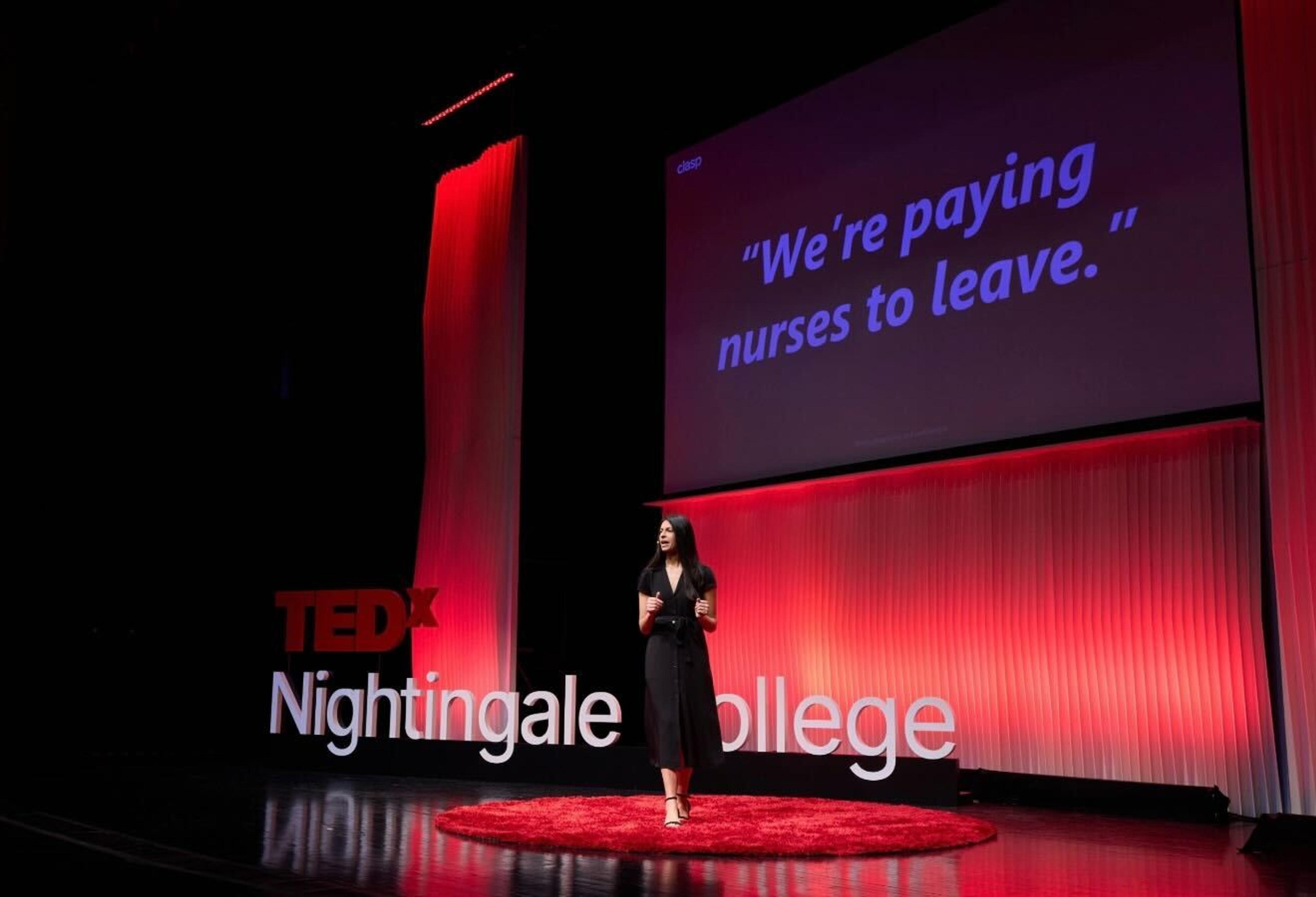
A VP of HR at a major hospital system recently put it plainly: "We're paying nurses to leave." Her hospital offered a $10,000 sign-on bonus to join — then watched that nurse take a $15,000 bonus to leave for a competitor, and another $15,000 to leave again just 18 months later. It's a pattern repeating itself across health systems nationwide, and it's costing the industry billions while doing almost nothing to actually keep clinical staff.
According to the 2025 NSI National Health Care Retention & RN Staffing Report, the average cost of replacing a single staff RN has climbed to $61,110 — up 8.6% from the year prior. Hospitals lose between $3.9 million and $5.8 million annually from RN turnover alone, with a national average turnover rate still sitting at 16.4%. The question is whether sign-on bonuses are solving that problem — or funding it.
Clasp's founder Tess Michaels recently gave a TEDx talk on on why the healthcare system is designed for turnover, not teamwork.
Watch It HereWhat the Data Actually Says About Sign-On Bonuses
A Laudio analysis of more than 50 U.S. hospitals found that a typical $10,000 sign-on bonus produces only about $2,800 in retention value. Hospitals that consistently offered bonuses saw a 24-month RN retention rate of 66.3%, compared to 61.0% for those that didn't — a 5.3 percentage point difference. For a benefit that can cost tens of millions annually across a large system, that's a remarkably thin return.
The structural reason is simple: bonuses reward joining, not staying. Once the check clears, the incentive is gone. What follows is predictable — nurses aren't disloyal, they're rational. They leave, as Clasp's Tess Michaels argues in her TEDx talk, not because they stopped caring, but because the financial math stopped working in their favor.
The Structural Problem Underneath
Sign-on bonuses are a downstream reaction to a system that was never designed for retention. Clinical training now costs more and takes longer than ever — degree requirements for roles like nurse anesthesia and physical therapy have escalated to doctoral level, and recent federal changes capped student loans for these programs, leaving students to cover as much as $100,000 in costs on their own. Clinicians arrive on the job carrying enormous financial stress, and the industry's response — billions in reactive sign-on bonuses and contract labor — does nothing to address the underlying burden.
The result is a workforce that entered healthcare with real purpose but gets worn down by financial pressure that compounds, not eases, in the early career years. Michaels lays out this dynamic in full in her TEDx talk, including where the military's ROTC model offers a surprising template for how healthcare could fix it.
What Actually Works
Employer-sponsored student loan repayment addresses the problem at the source. Rather than a one-time payment that disappears, monthly loan repayment contributions create a continuous financial relationship between employer and employee — one that compounds over the retention period and reinforces commitment in a way bonuses can't.
The ROI case goes beyond just replacing sign-on bonuses. Congress made permanent the arrangement allowing employers to contribute up to $5,250 per year tax-free under IRS §127. The downstream savings add up quickly: it means attracting and converting talent in a way earlier, and more uniquely, than competitors down the road. It means actually incentivizing clinicians to stay, building a tenured and stable workforce. And that retained clinician means no contract labor to cover the gap while the role sits vacant and no overhead chasing clawback repayments from nurses who left before their vesting period.
The Bottom Line
A clinician's decision to stay shouldn't come down to who's offering the next bonus. Rather, it should come from a system that invested in them before their first shift — and keeps investing. For healthcare HR and talent leaders ready to move from reactive spending to retention infrastructure, the data points in one direction.
For a deeper look at how healthcare got here — and what a better system looks like — watch Tess Michaels' full TEDx talk, "Stop Paying Nurses to Quit." or schedule time to chat with the Clasp team.
Schedule Time To Learn More