2026 Is the Year of the Talent Pipeline: The 3 Workforce Shifts Health Systems Must Make Now
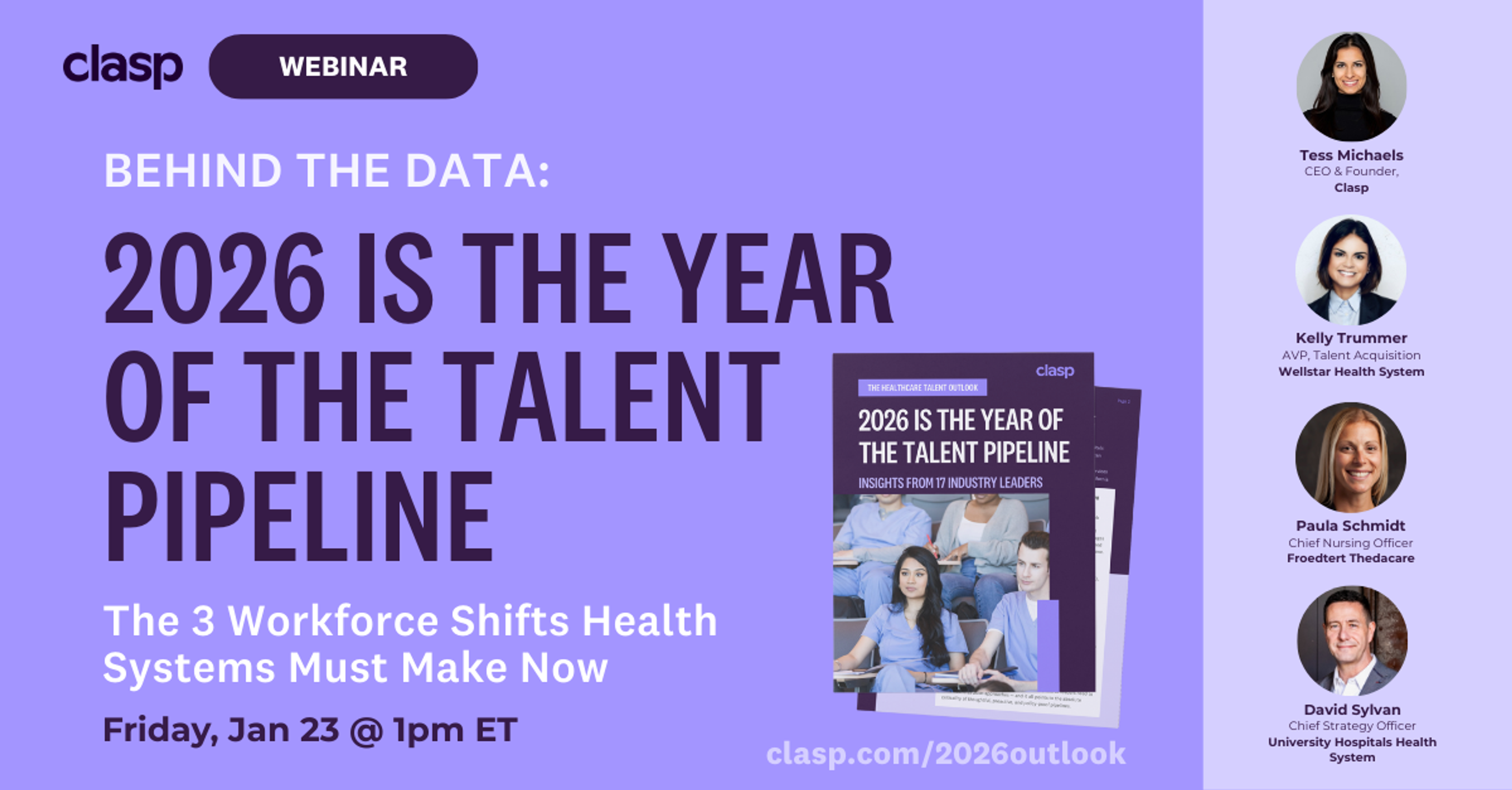
WEBINAR REPLAY | 1.23.2026
What leaders at University Hospitals, Froedtert, and Wellstar say health systems must change now to improve retention and rebuild clinical pipelines.
Healthcare workforce challenges now threaten care delivery. Nurse turnover approaches 50% within two years. CRNA, PT, and allied health pipelines continue to shrink. Many regions still lack access to clinical training programs.
In January 2026, Clasp convened healthcare leaders from University Hospitals, Froedtert, and Wellstar Health System to discuss what must change. Their conclusion was clear: health systems that rely on traditional recruiting alone will fall behind. Leaders must redesign clinical talent pipelines around retention, education access, and speed.
Workforce Shift #1: Retention Is the Clinical Pipeline
Health systems can no longer treat retention and recruitment as separate strategies. Retention now supplies the most reliable source of future clinical staff.
David Sylvan, Chief Strategy Officer at University Hospitals, emphasized that improving clinician retention prevents vacancies before they require backfilling. The data is compelling: even small gains reduce RN turnover costs, which can exceed $40,000 per nurse and more than $260,000 annually per 1% change in turnover.
Leaders see the strongest retention impact when they:
- Enable internal mobility across units and specialties
- Make clinical career pathways visible and explicit
- Support clinicians most heavily in their first two years
Action for leaders: Model turnover costs by role and treat retention investments as core clinical pipeline strategy.
Workforce Shift #2: Education Has Become the Bottleneck
Retention stabilizes today’s workforce, but education determines future supply. Federal student loan caps and rising training costs now constrain graduate nursing, CRNA, PT, and OT pipelines (you may recall the "nursing not a professional degree" panic that ensued when the changes we proposed last Fall – our full breakdown of what this means and who it impacts here). Geography worsens the problem—nearly 30% of U.S. counties lack allied health training programs.
Health systems are responding by:
- Upskilling internal employees into CNA, MA, surgical tech, and even advanced clinical roles
- Offering loan repayment tied to post-graduation service commitments that incentivize retention
- Recruiting from regions with surplus clinical graduates
At Froedtert, opening surgical tech training to internal staff generated nearly 100 applicants, demonstrating that demand exists when financial barriers disappear.
Action for leaders: Identify one role where education—not demand—limits hiring and build a focused, funded pipeline.
Workforce Shift #3: Speed and Focus Beat Perfect Plans
Traditional workforce planning moves too slowly for current clinical labor shortages. Successful systems act faster by:
- Focusing on one role at a time
- Running 90-day pilots instead of multi-year rollouts
- Reassessing progress quarterly
Kelly Trummer, AVP of Talent Acquisition at Wellstar, urged leaders to start with the role creating the most operational strain—often radiologic technologists, respiratory therapists, PTs, or CRNAs.
Action for leaders: Launch one clinical pipeline initiative within the next 60 days, measure early results, and iterate quickly.
A Simple Framework for 2026: Now, Near, Far,
Paula Schmidt, CNO at Froedtert, summarized the approach many systems are adopting: a now–near–far clinical workforce strategy..
NOW (0–90 days):
- Pilot a retention or documentation-reduction initiative
- Survey staff interest in clinical career pathways
- Launch a loan repayment-backed pipeline for a critical role
NEAR (3–12 months):
- Scale successful pilots across units or roles
- Formalize internal upskilling programs
- Expand education and loan repayment tied to retention commitments
FAR (1–3 years):
- Build specialty and leadership pathways
- Establish durable academic partnerships
- Use near-term data to guide long-range workforce planning
Key Takeaway for Healthcare Leaders
David Sylvan captured the moment well: healthcare systems no longer have the luxury of slow experimentation. What feels “far” today becomes urgent faster than expected—especially when nurse turnover, allied health shortages, and training bottlenecks compound. Workforce degradation is happening faster than traditional planning cycles can respond—meaning innovation has to move from “future-state” to near-term execution.
That’s why many systems are choosing to act now on loan repayment: it’s one of the few clinical pipeline strategies that delivers immediate recruiting lift, near-term retention impact, and long-term workforce stability—without waiting on new programs or policy changes.
As Paula put it during the webinar: “You don’t need to solve everything. You just need to start.”
Resources
- 🎥 Watch the Full Webinar Recording: Linked Here
- 💬 Explore Clinical Pipeline Solutions: Connect with our team for a strategy session
- 📊 Download the 2026 Talent Outlook Report: https://clasp.com/talentoutlook2026