America's Future Nurses Are Betting on Kalshi to Pay for School
At Clasp, we spend our days at the intersection of healthcare students and the money it takes to be one. We see how tuition gets paid: the loans, the employer help, the family help, the second jobs. So when a student mentioned that classmates were using Kalshi to cover expenses, it caught our attention, because in years of these conversations, that was a first.
Nursing is supposed to be the safe bet. It's the career economists say AI can't automate, and the Bureau of Labor Statistics projects 35% job growth for advanced-degree nurses through 2034. Which raised a question we realized nobody had answered with data: if the destination is that secure, how are students actually paying to get there?
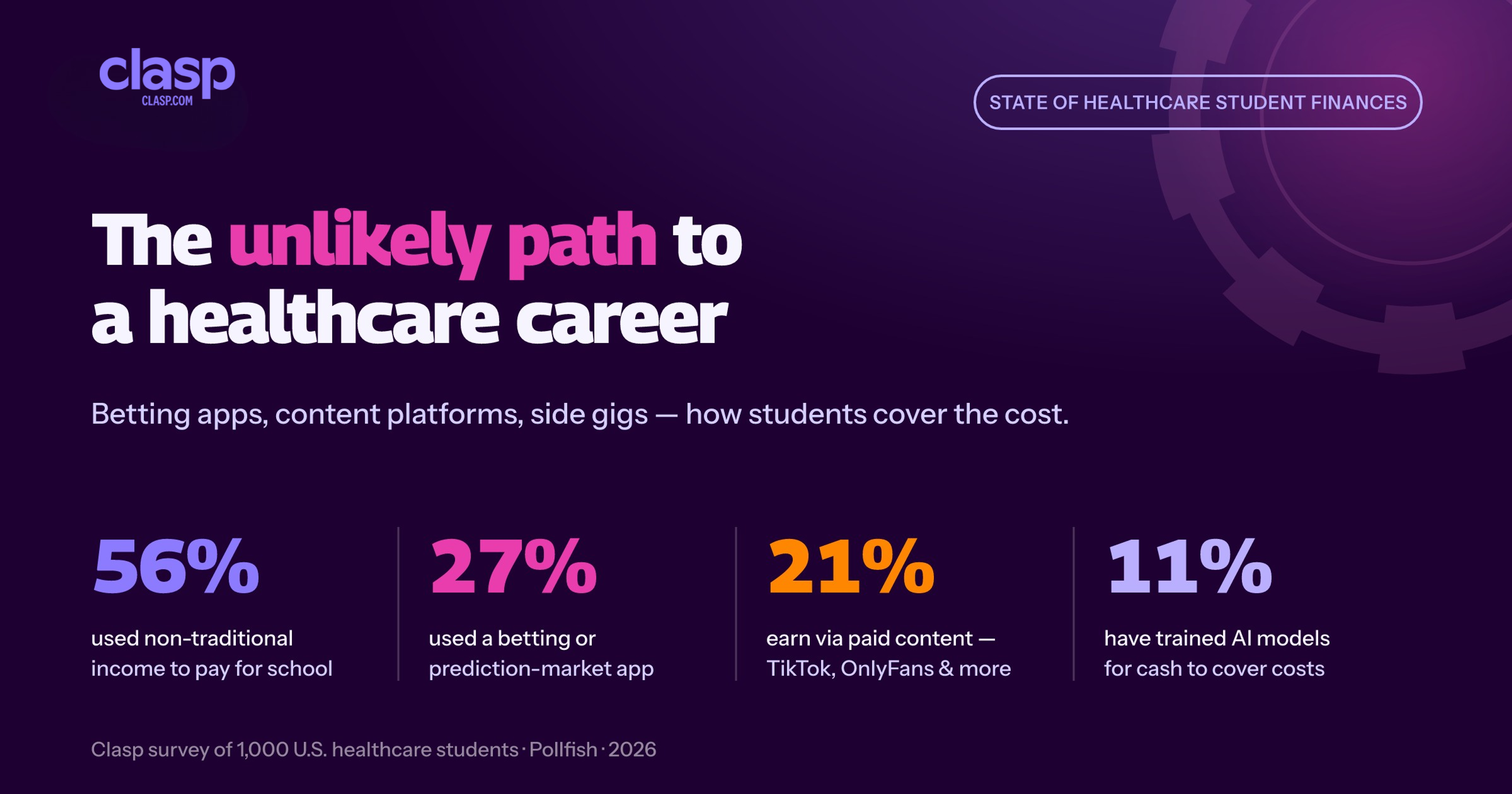
So we asked 1,000 of them. We expected side hustles. We didn't expect a quarter of them on betting and prediction platforms, with winnings written into tuition plans.
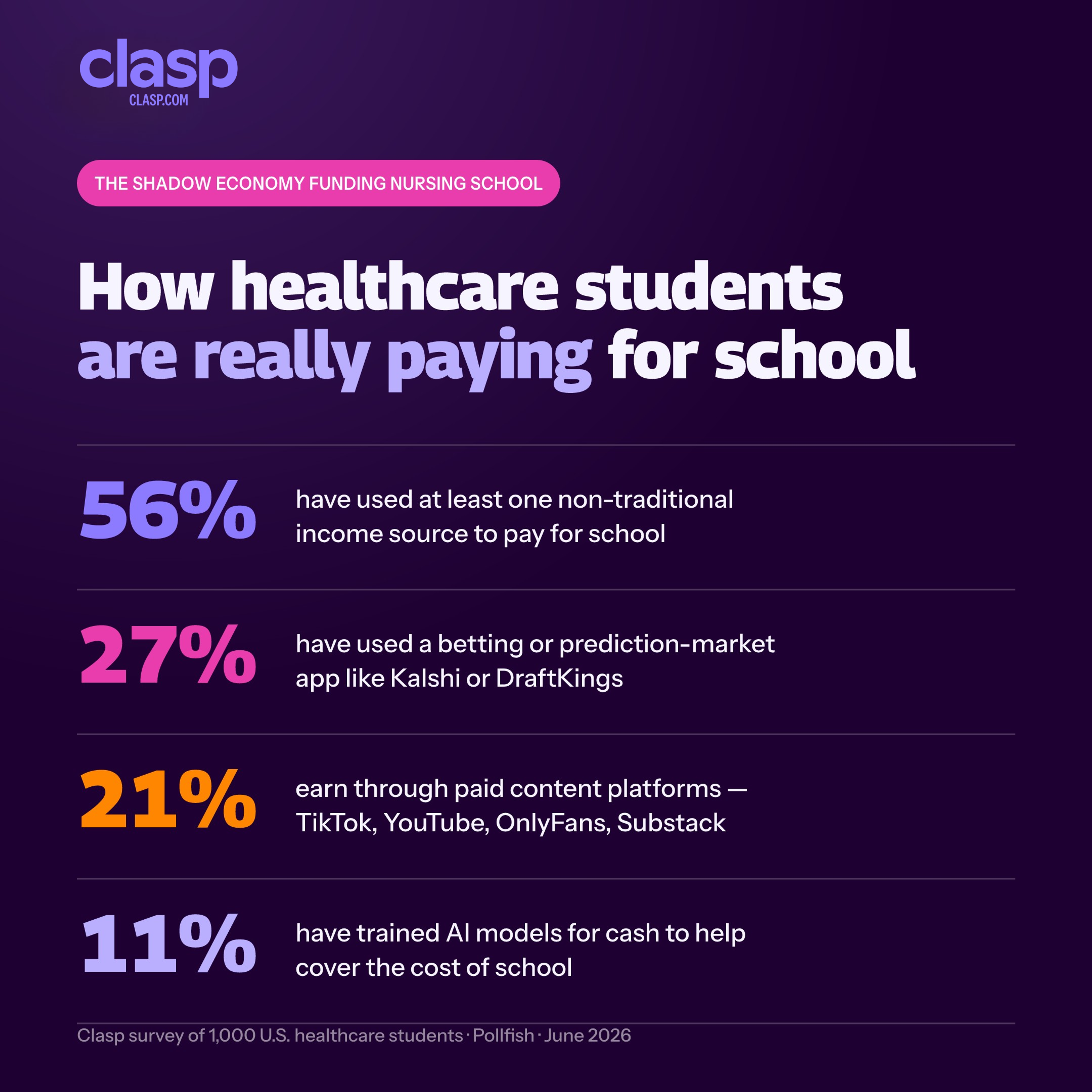
More than half of future clinicians are funding their training with income the financial-aid system never sees.
This revelation arrives at a pivotal moment. On July 1, 2026, new rules went into effect that create lifetime Federal borrowing limits that leave some programs with 50% or more of the cost unfunded.
THE FINDING
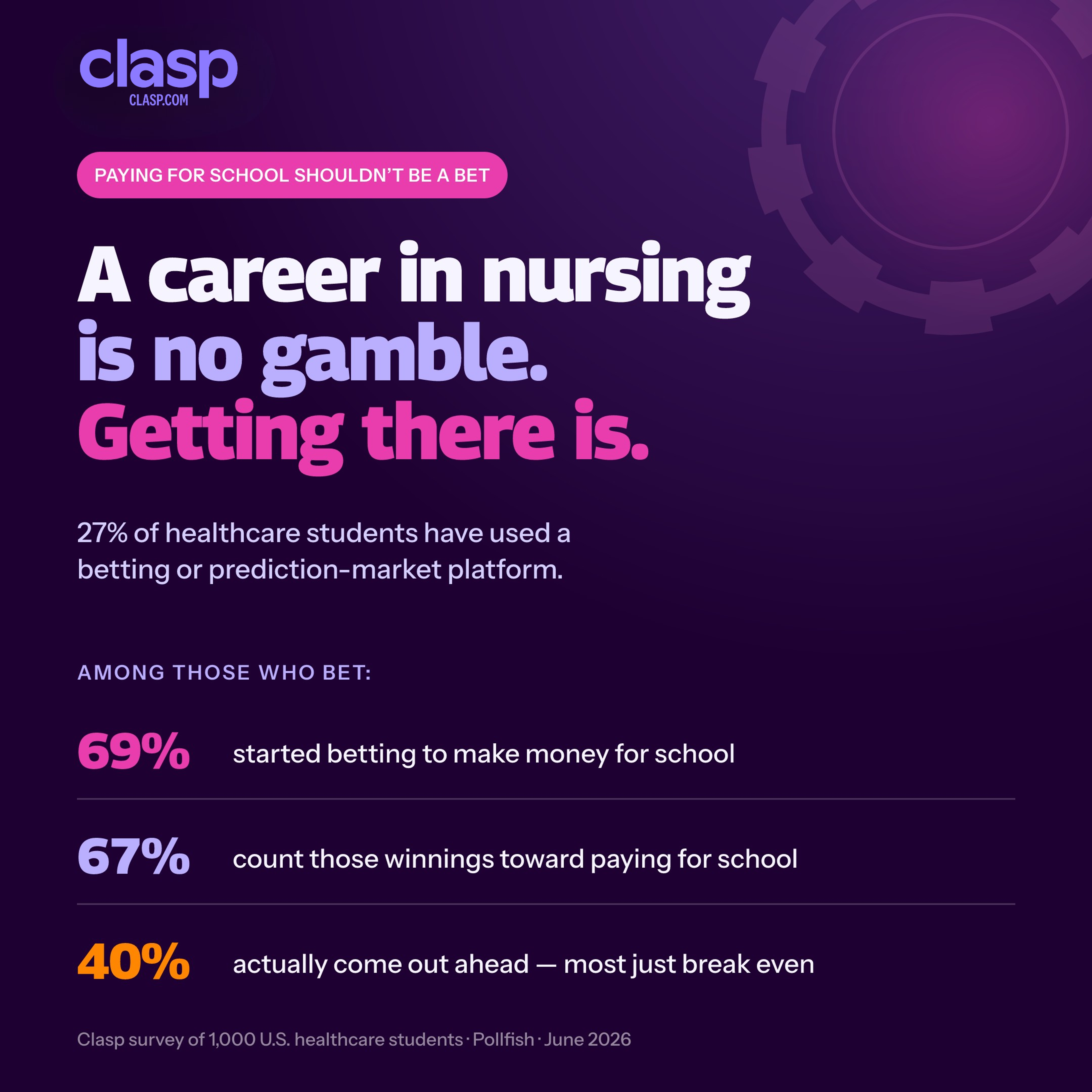
More than 1 in 4 are betting on their tuition.
Betting among future clinicians isn't a weekend hobby. It's habitual, it's more frequent than among their peers nationally, and it's rarely for fun. Most who bet started doing it to make money for school, and regardless of how they got into it, two-thirds now count their winnings as money they're relying on to pay for it.
The problem is the long-term math. About half of student bettors say they roughly break even, and only 40% come out ahead — yet those winnings are already written into their tuition plans.
WHO'S BETTING
1 in 5 women in our survey have bet. That's double the national rate.
Here's the part of the data that made us look twice. Betting skews male everywhere, in every national dataset, on every platform. Our survey is 81% women, because that's who healthcare students are. If betting behaved the way it does nationally, we'd have found a small pocket of bettors and moved on.
That's not what we found. Nearly half the men in our survey (49%) have used these platforms, which tracks with betting culture at large. But about 1 in 5 women have too, and that's roughly double the rate at which American women bet on sports. The betting boom didn't skip the most female profession in the country. It found it.
And the women who bet aren't dabbling. They bet as often as the men do, and they started for the same reason: money for school.
THE BIGGER PICTURE
The rest of the shadow economy.
Betting is just one line in a longer ledger. Heavy credit-card use and paid content creation — TikTok, YouTube, OnlyFans, Substack — are just as common, and for a growing share of students the side hustle has quietly become the financial-aid plan. Others train AI models for cash or turn to egg and sperm donation.
THE PRESSURE
A career that already feels out of reach.
These students were stretched thin well before the new borrowing caps hit. A majority say a healthcare career is extremely difficult or out of reach without family money, and nearly a third can't reliably cover a month of basic expenses. Most are also navigating the July 1 borrowing changes half-blind — the majority had never heard of them.
Here's the finding that reframes everything else: they're not leaving. Two-thirds chose healthcare to help people, not for the paycheck. Almost none are reconsidering because of the caps — and many say the caps make them more determined to finish. The commitment isn't the problem. The financing is.
"Nursing is supposed to be the career that holds when everything else gets automated away, and we've made it harder to finance than law school. These students aren't betting for fun — they're budgeting winnings into their tuition plans, and most of them aren't coming out ahead. What struck me most is that they're staying anyway. The commitment isn't the problem. The financing is."
— Tess Michaels, CEO of Clasp
THE TAKEAWAY
What this means — for employers and students.
For employers, this is a recruiting signal hiding in plain sight: the future clinical pipeline is financially fragile exactly as demand for care climbs. The strongest lever to shape that workforce is to remove the financial barrier between a motivated student and the finish line. At Clasp, we tie student loan repayment to long-term employment — helping health systems attract clinicians earlier and keep them longer, treating loan repayment as core recruiting strategy, not a perk. Meet with our Director of Healthcare Partnerships to see how Clasp can support your workforce goals.
For students, you're probably already seeing — or part of — the shadow economy funding tuition. The takeaway is that the system is failing thousands of committed people, and there are better options than a maxed-out card. Employer-sponsored repayment programs are expanding fast and can be worth far more than a sign-on bonus over a career. See how Clasp connects students with employers who invest in their training.
Methodology: Clasp surveyed 1,000 U.S. healthcare students via Pollfish, June 16–28, 2026 (81% female, 84% under age 36), spanning nursing, allied health, and other healthcare programs. National comparisons are drawn from published NCAA and Statista data; the job-growth figure is from the U.S. Bureau of Labor Statistics.